
Who Killed Jesus?

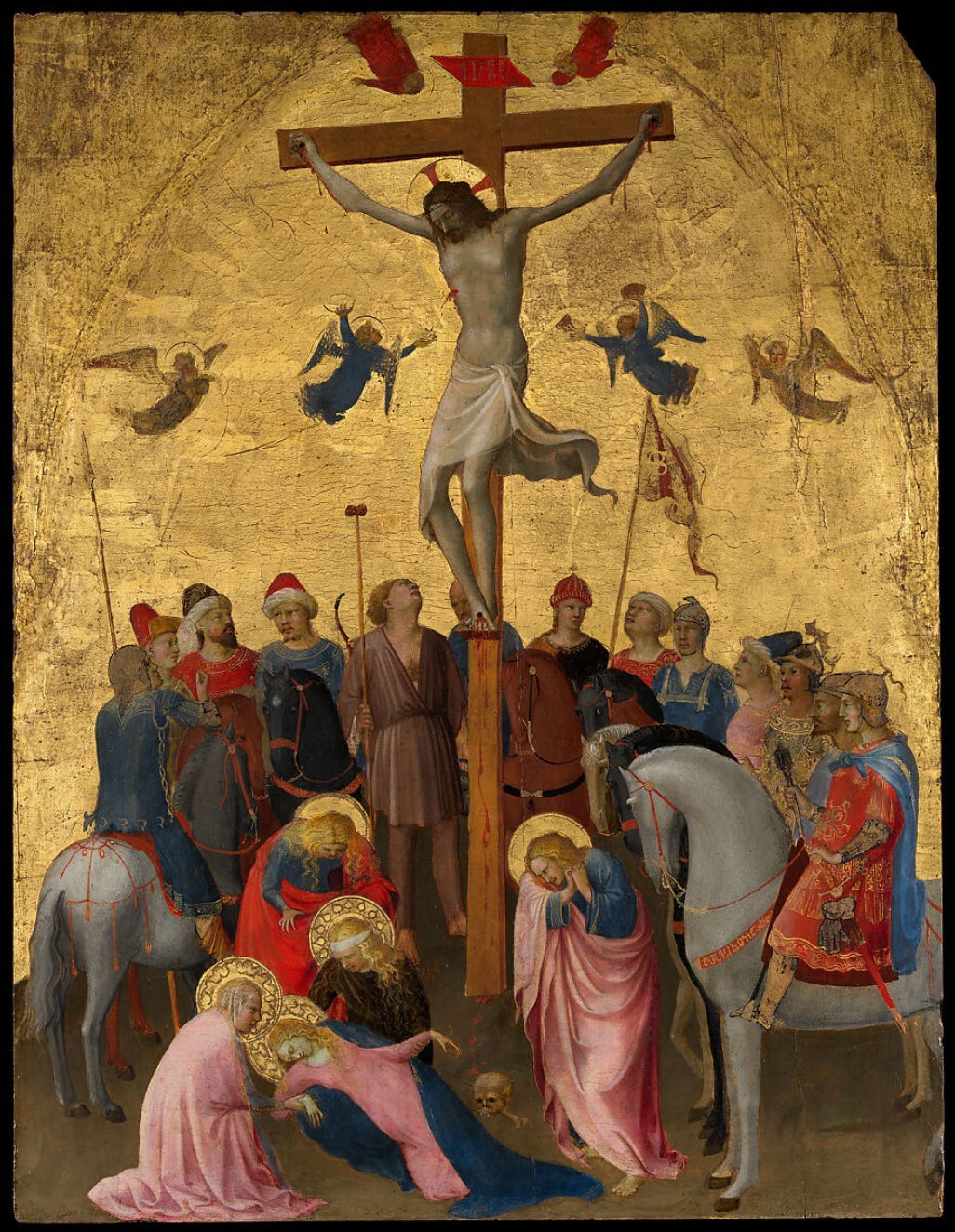
“The Crucifixion”
Fra Angelico (Guido di Pietro) - ca. 1420-23
You may be seeing a claim on social media that suggests (or states) that Jesus was killed by the Roman Empire because Rome couldn’t tolerate a dissident voice that threatened its way of life. I can understand why this explanation has appeal. It rightly avoids the toxic and historically false claim that “the Jews killed Jesus,” a phrase that has done incalculable harm. It also names Rome’s brutality and reminds us that crucifixion was a Roman punishment.
But as an explanation for who killed Jesus, it doesn’t quite work.
Historically speaking, Rome likely did not execute Jesus because his teaching posed some deep ideological threat to Roman culture or values. Rome was not especially interested in Jesus’ theology, parables, or moral vision. Based on what we know, they crucified people efficiently and often preemptively, especially if those people were perceived—rightly or wrongly—as potential sources of instability to the system as a whole.
So what did happen? Good question.
Many scholars reconstruct the event like this:.
First, a baseline that matters: Jesus was executed by Rome. Crucifixion was a Roman form of capital punishment, carried out by Roman authority. Whatever role others may have played, Rome bears responsibility for the execution itself.
Second—and this is just as important—“the Jews” did not kill Jesus. Jesus was a Jew. His followers were Jews. His opponents were Jews. The idea of collective Jewish guilt is not only morally abhorrent, but it is historically incoherent.
At the same time, in the events that led to Jesus’ death, the New Testament does point to the involvement of some Jews, specifically, a small group of Jerusalem elites connected to the Temple. So, not “the Jewish people,” but certain leaders in positions of religious and political authority.
This is where a more historically grounded explanation begins to take shape.
Many scholars argue that Jesus became dangerous not because he challenged Rome directly, but because he became a problem in Jerusalem, particularly during Passover. Passover was a festival charged with national memory and hope, and Rome watched it closely.
His symbolic action in the Temple of turning over the money changer’s tables, whatever precise form it took (that is debated), flagged Jesus as someone who could disrupt an already volatile situation.
As E. P. Sanders famously argued, it was Jesus’s action at the Temple that precipitated his arrest. The issue was not abstract theology but public symbolism in a highly sensitive space. The Temple authorities were responsible for maintaining order, and a prophetic figure drawing crowds and criticizing Temple practices represented a genuine risk.
Crucially, the language of messiahship plays a central role here—but not in the way it is often understood. There is little evidence that Jesus went around explicitly calling himself “the Messiah” in a way designed to provoke Rome. But messianic hopes were in the air, and the title “Messiah,” that others likely gave him, translated easily into Roman political categories. A Messiah could quickly become king, and a king was a suggestion Rome did not tolerate.
This is where Jewish leaders and Roman power intersect. Scholars such as Paula Fredriksen emphasize that Jesus’ messianic significance became politically lethal only when filtered through Roman suspicion—especially at Passover. In that context, some Jewish leaders presenting Jesus as a possible “king of the Jews” was a way of forcing Rome’s hand.
From Rome’s perspective, the charge that mattered was not blasphemy or Sabbath violation, but sedition. That is why the charge posted on the cross, “Jesus of Nazareth King of the Jews”, was political, not theological.
As Raymond E. Brown carefully showed in his work on the Passion narratives, the Gospels preserve memories of Jewish involvement in handing Jesus over to Roman authorities, while consistently portraying Rome as the agent of execution.
Later Gospel writers, writing after the destruction of the Temple in 70 CE and amid strained Jewish-Christian relations, accentuate Jewish culpability and soften Roman responsibility. However, that literary shaping should not be confused with historical fact. Laying blame on Jews and presenting Rome (namely Pilate) as reluctant to execute Jesus, is commonly seen today as a move to keep from getting on Rome’s bad side.
Similarly, John P. Meier and Bart Ehrman both argue that Jesus was executed as a messianic pretender, not because he led a revolt, but because, in a tense political climate, his symbolic actions and perceived claims could not be ignored.
Put simply: Jesus was not killed because Rome found his message intolerable. He was killed because a small group of local Jewish leaders perceived him as a destabilizing threat and successfully framed that threat in terms Rome understood and would act upon.
Rome made the final decision. Rome carried out the execution. But Rome did not act without influence
This explanation avoids antisemitism without flattening history. It takes Roman violence seriously without turning Jesus into a failed revolutionary. And it reminds us that the crucifixion emerges not from a simple villain narrative, but from a convergence of fear, power, miscalculation, and political reality.
Though that may be less satisfying than a single culprit, it is far closer to the truth.
This was great. Would love to see a part 2 to this that explores the theological “reasons” Jesus was crucified (in contrast to say PSA, etc).
I would like to better understand the post resurrection theology: Jesus died for our sins. Why did that become the story we tell? And once that is better understood what happens to Christianity?